

For the first time in years, homebuyers are beginning to regain some control.
Homes are sitting on the market longer in many cities. Sellers are becoming more open to negotiations. Builders are cutting prices, paying closing costs and offering mortgage-rate buydowns to attract hesitant buyers.
The number of homes available for sale is also improving in several parts of the country, including markets where buyers once had to compete against multiple offers within hours of a property being listed.
On the surface, this sounds like the buyer’s market people have been waiting for.
But there is a major problem.
Although buyers have more negotiating power, they have considerably less purchasing power than they did just a few years ago.
Mortgage rates remain elevated. Home prices are still near record levels. Property taxes and homeowners insurance have risen in many areas. Even when sellers agree to lower prices, the monthly payment can remain out of reach for the average household.
That has created one of the strangest housing markets in recent memory:
Buyers have more choices, more concessions and more time to negotiate—but many still cannot afford to complete the purchase.
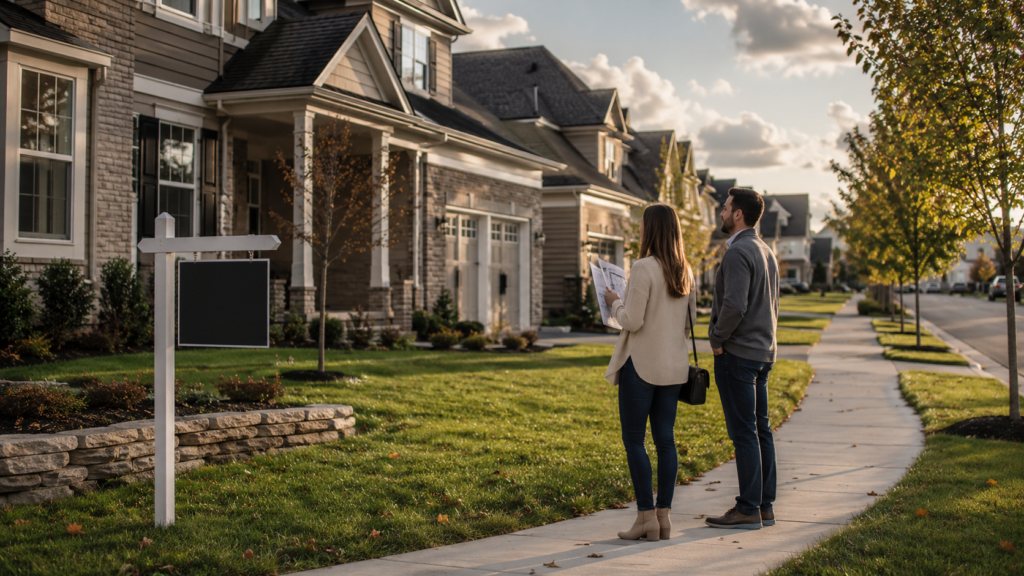
The Housing Market Is No Longer Moving at Pandemic Speed
The housing market of 2020 and 2021 was defined by urgency.
Buyers frequently competed against multiple offers, waived inspections and agreed to purchase homes above the asking price. Some submitted offers without seeing the property in person. Others offered appraisal-gap coverage or allowed sellers to remain in the home after closing.
A home could be listed on Thursday, receive dozens of showings over the weekend and be under contract by Monday.
That market has largely disappeared.
Pending home sales fell 5.4% from May to June 2026, according to the National Association of Realtors. Contract signings declined month over month in every major region of the country.
The Midwest experienced the steepest monthly decline, followed by the West, South and Northeast.
Pending sales are important because they measure contracts that have been signed but have not yet closed. When pending sales decline sharply, it often suggests that completed transactions may remain weak in the following months.
Existing-home sales also declined during June, while the national median existing-home price reached approximately $440,600.
That combination reveals the central problem facing the current market:
Fewer homes are selling, but the homes that do sell remain expensive.
Sellers have lost some of the overwhelming leverage they enjoyed during the pandemic, but prices have not fallen enough nationally to create a broad affordability reset.

Sellers Are Beginning to Make Concessions
The clearest sign that the market is shifting toward buyers is not necessarily a dramatic collapse in home prices.
It is the growing number of sellers who are willing to negotiate.
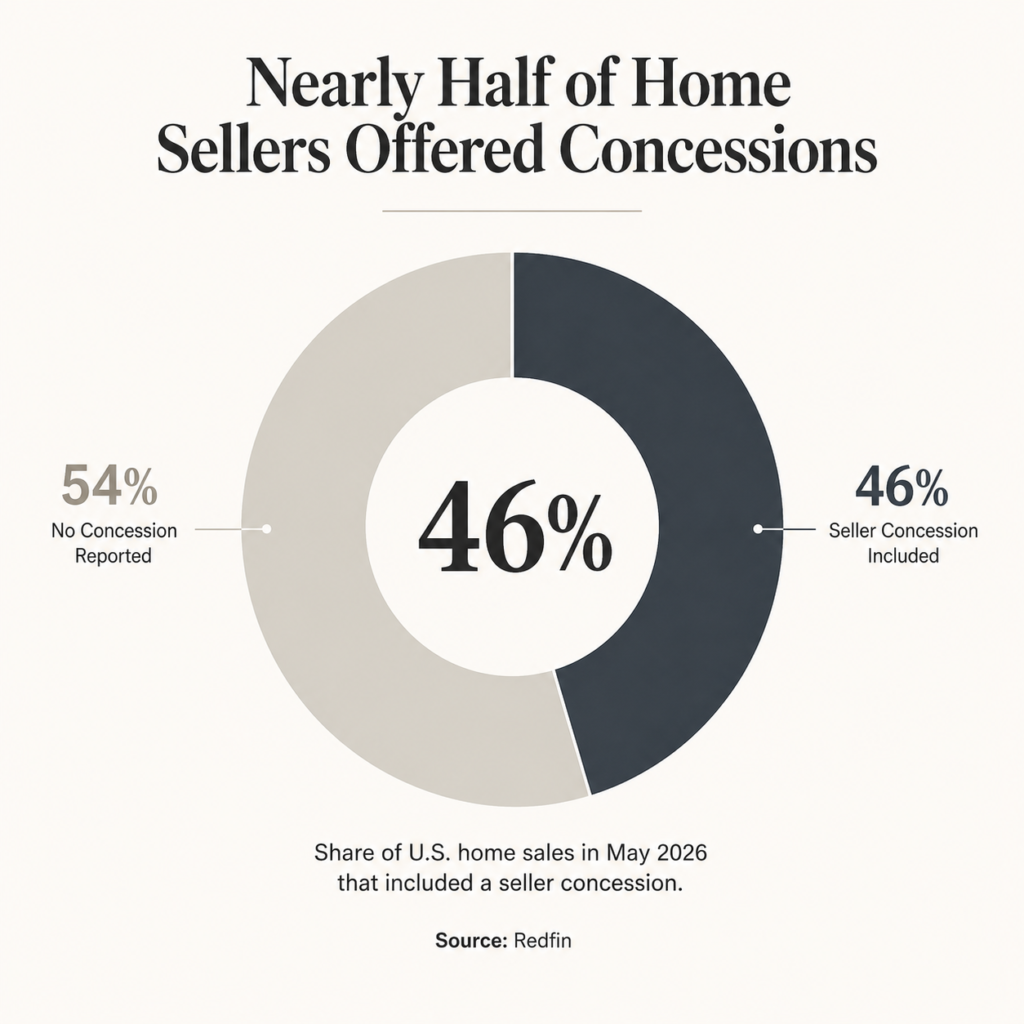
Redfin found that sellers provided concessions in approximately 46% of U.S. home sales in May 2026. That was higher than the previous year and represented an unusually large share for the spring selling season.
A seller concession is different from a traditional price reduction.
Instead of lowering the advertised price, the seller may agree to help the buyer cover other expenses associated with the purchase.
Common concessions include:
- Closing-cost assistance
- Mortgage-rate buydowns
- Inspection-related repairs
- Home warranties
- HOA fees
- Appliance allowances
- Credits for flooring, paint or other updates
- Assistance with prepaid taxes and insurance
These concessions can be especially valuable for buyers who have enough income to qualify for the mortgage but are struggling with the amount of cash required at closing.
A seller may also prefer offering a concession instead of reducing the price because the home can still appear to have sold closer to its original asking price.
The trend is particularly noticeable in several Southern and Sun Belt markets.
In Redfin’s May analysis, sellers provided concessions in a large majority of transactions in markets including Nashville. Concessions were also common in Charlotte, Atlanta, Phoenix and Raleigh.
By comparison, they were less common in highly supply-constrained markets such as New York and parts of coastal California.
That means there is no single national housing market.
A buyer shopping in Nashville, Phoenix or Atlanta may have substantially more negotiating power than a buyer competing in Boston, New York or San Jose.
Homebuilders Are Competing for Buyers Too
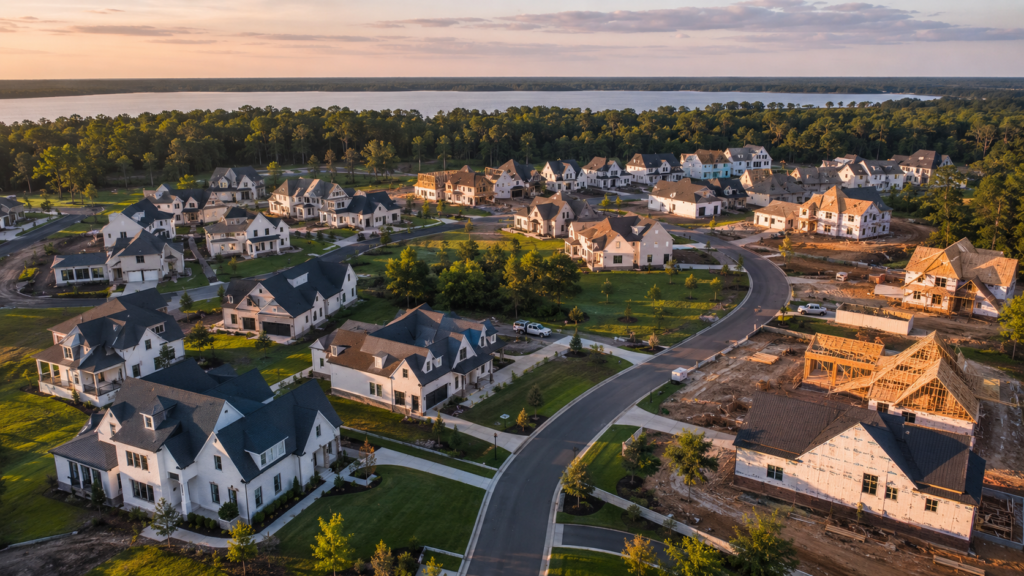
The shift toward buyers may be even more obvious in new construction.
Builder confidence fell to 34 in July, according to the National Association of Home Builders and Wells Fargo Housing Market Index.
A reading below 50 indicates that more builders view market conditions as poor than good.
Builders are responding by offering deals.
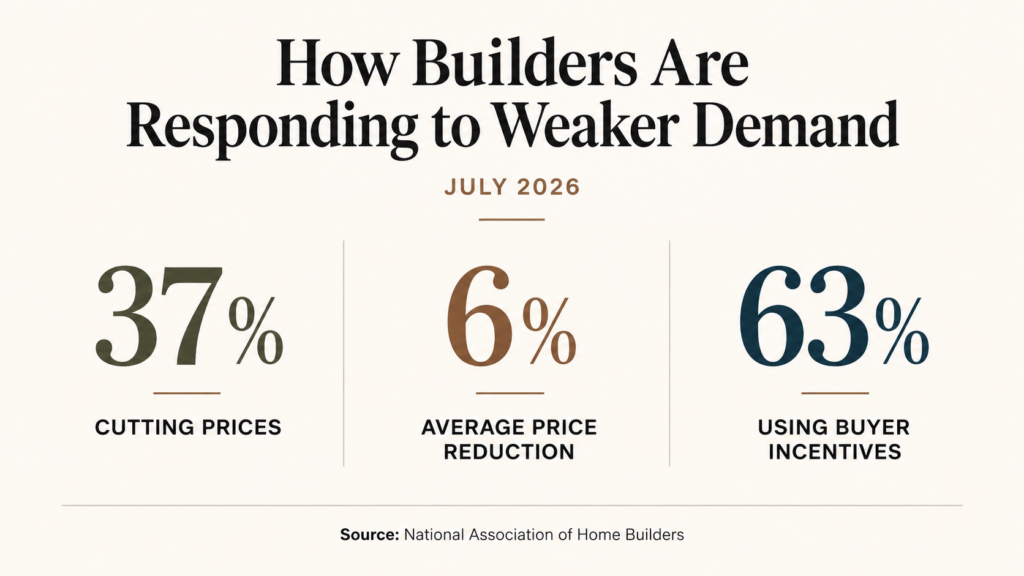
In July:
- 37% of builders reported cutting prices
- The average reported price reduction was approximately 6%
- 63% of builders reported using sales incentives
The share of builders using incentives has remained elevated for more than a year.
That is a major departure from the pandemic market, when buyers often waited months for a home to be completed and builders had little reason to negotiate.
Today, a builder may offer a package that includes:
- A temporary or permanent mortgage-rate buydown
- Money toward closing costs
- Upgraded countertops or flooring
- Included appliances
- Reduced lot premiums
- A lower base price
- Assistance with HOA fees
- Flexible move-in timelines
The most valuable incentive is not always the largest advertised discount.
A $10,000 price reduction may sound impressive, but it might only reduce the monthly mortgage payment by a relatively small amount.
A mortgage-rate buydown could potentially create a larger monthly savings, depending on the cost, the rate reduction and how long the buyer plans to remain in the home.
Closing-cost assistance may be more useful to a buyer who has strong income but does not want to drain savings to complete the purchase.
Buyers should ask the lender to calculate the real financial benefit of each offer instead of focusing only on the headline number.
Construction Data Reveals a Divided Market
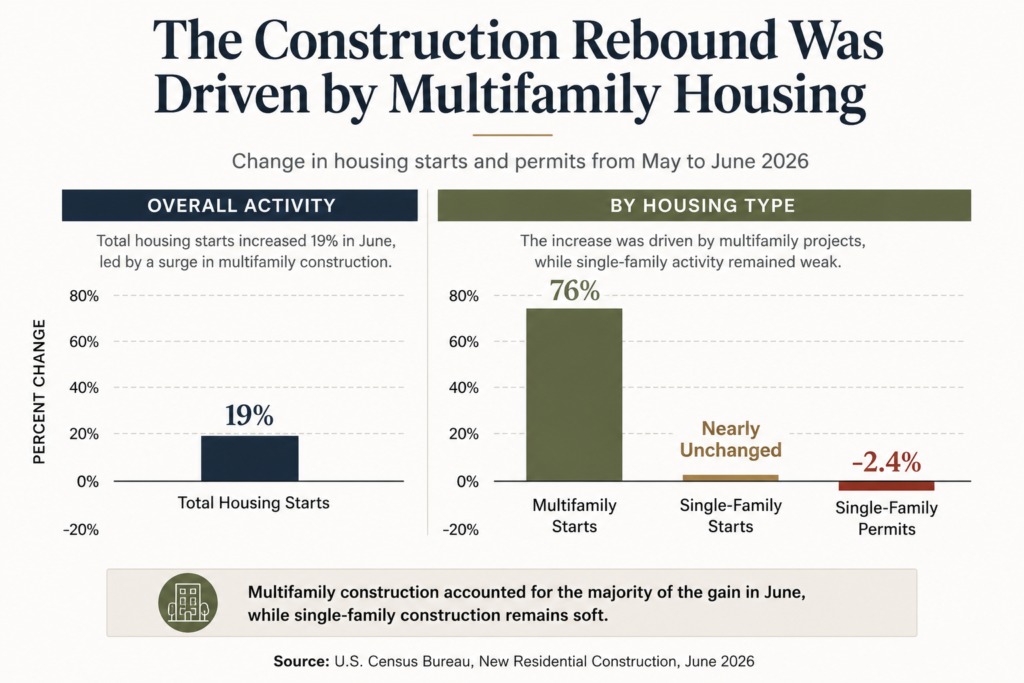
Recent construction numbers can be misleading unless they are separated by housing type.
Total housing starts increased sharply in June, but much of that increase came from multifamily construction.
Apartment and condominium projects can create large monthly swings in the total number of housing units started. A single large development may contain hundreds of units.
Single-family construction remained much weaker.
Permits for future single-family construction also declined, suggesting builders are cautious about starting another large wave of detached homes while completed inventory remains available.
Builders are dealing with several pressures at once:
- High construction-loan costs
- Expensive materials
- Labor shortages
- Rising insurance costs
- Expensive developable land
- Buyers who are increasingly sensitive to monthly payments
Many builders need to sell existing inventory before beginning additional projects.
This helps explain why builders can offer aggressive incentives even though the United States continues to face a longer-term housing shortage in many communities.
The country can have a structural housing shortage while simultaneously having a temporary surplus of homes that buyers cannot afford at current prices and mortgage rates.
Starter Homes Are Returning—But Affordability Has Not
There is some encouraging news for first-time buyers.
The supply of starter homes has improved from the extreme lows reached during the pandemic.
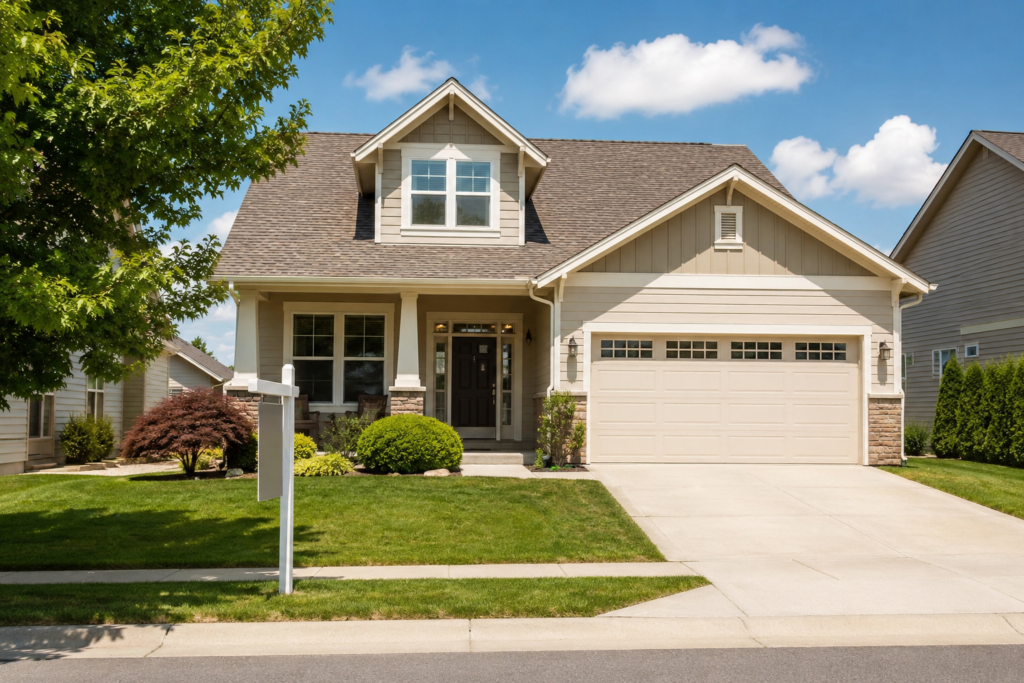
There are approximately 220,000 more starter homes available than at the low point in 2022, while the typical starter-home price has declined modestly from its recent peak.
But the improvement needs to be placed in context.
The market still has approximately 300,000 fewer starter homes than it did in 2019.
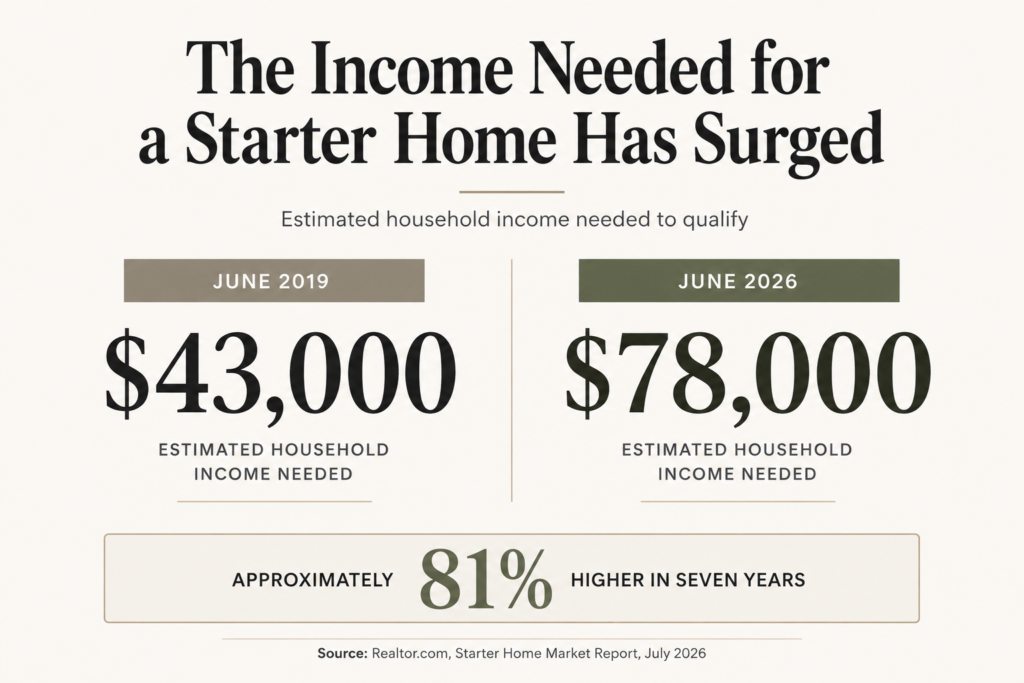
More importantly, the estimated household income needed to qualify for a starter home has increased from roughly $43,000 several years ago to approximately $78,000 today.
That is the huge catch.
A starter home can return to the market without becoming genuinely affordable.
A house listed for $325,000 may technically qualify as a starter home in its local market. But once the mortgage payment, property taxes, insurance, HOA fees and maintenance costs are included, the house may still require a household income far above what many first-time buyers earn.
The recovery in starter-home inventory is also uneven.
The South has experienced some of the strongest improvement because years of residential construction created more available homes.
Some Western markets have also experienced price reductions and growing inventory.
The Northeast and portions of the Midwest remain much tighter because fewer homes have been built and owners with low mortgage rates remain reluctant to sell.
Mortgage Rates Are Erasing Much of the Buyer’s Advantage
Mortgage rates are the primary reason additional inventory has not translated into a broad affordability recovery.
The average 30-year fixed mortgage rate remains in the mid-to-upper 6% range.
That may not sound dramatically different from rates above 7%, but it is still more than twice the ultra-low rates available during portions of the pandemic.
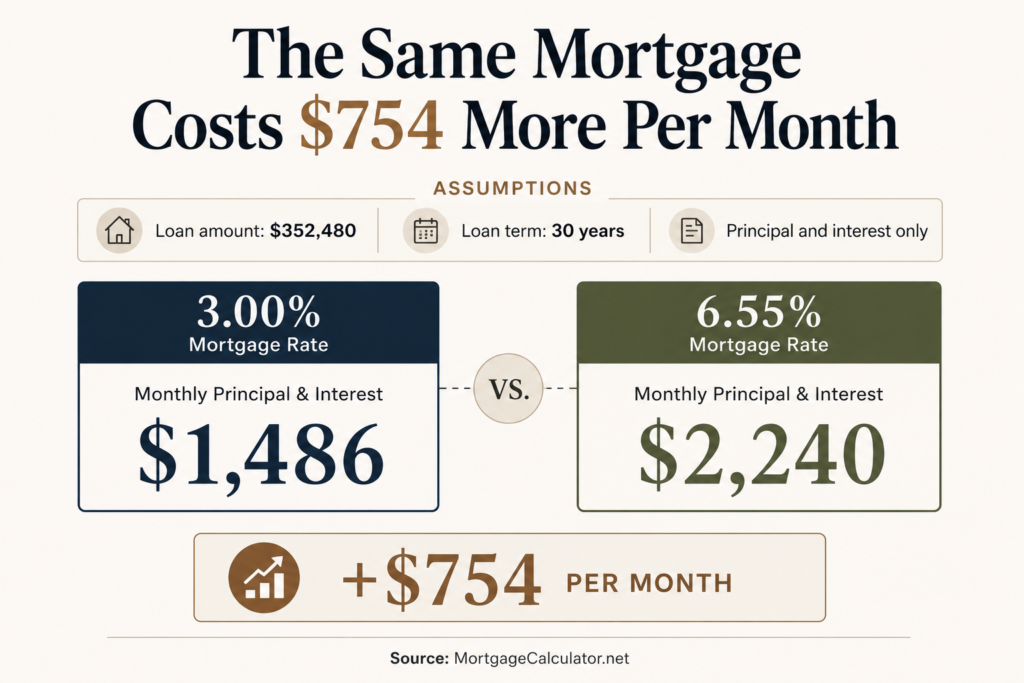
To understand the impact, consider a buyer purchasing a home at approximately the national median existing-home price of $440,600.
With a 20% down payment, the buyer would borrow approximately $352,480.
At a 3% mortgage rate, the principal-and-interest payment would be approximately $1,486 per month.
At a 6.55% mortgage rate, the payment would rise to approximately $2,240 per month.
That is a difference of roughly $754 every month, before adding property taxes, homeowners insurance, HOA fees or maintenance expenses.
Over one year, the higher rate adds more than $9,000 to the buyer’s principal-and-interest payments.
This is why a modest home-price reduction does not necessarily solve the affordability problem.
A seller could reduce the price by $10,000 or $20,000, and the buyer may still face a substantially higher monthly payment than someone who purchased a similar home when rates were near 3%.
Buyers Have Leverage, but They Are Not Necessarily Winning
The phrase “buyer’s market” can create the impression that homes are suddenly inexpensive.
That is not what is happening nationally.
A more accurate description is that the market is becoming buyer-friendly without becoming buyer-affordable.
Buyers may be able to negotiate more favorable contract terms. They may be able to keep inspection, financing and appraisal contingencies.
They may have time to compare several properties instead of making an immediate decision.
They may also be able to request closing-cost assistance or negotiate repairs that would have been rejected during the pandemic.
But buyers are still purchasing homes at historically high prices with mortgage rates that are considerably higher than they were a few years ago.
That leaves many households with three difficult choices:
- Purchase a smaller or less expensive home.
- Increase the amount of cash used for the down payment.
- Delay the purchase and hope that rates or prices eventually improve.
None of those choices is easy.
A smaller home may not meet the buyer’s long-term needs.
A larger down payment can drain emergency savings.
Waiting could help if affordability improves, but there is no guarantee that both rates and prices will decline at the same time.

What Buyers Should Negotiate Right Now
A slower market creates opportunities, but buyers need to know where to look for them.
Ask for a Mortgage-Rate Buydown
A seller or builder can contribute money that reduces the buyer’s mortgage rate, either temporarily or for the life of the loan.
A temporary buydown may reduce the rate during the first one, two or three years of ownership.
A permanent buydown uses money at closing to reduce the interest rate for the full loan term.
A permanent rate reduction may provide more long-term value than a modest reduction in the purchase price.
However, buyers should ask their lender to calculate both options before making a decision.
Request Closing-Cost Assistance
Closing costs can total thousands of dollars.
A seller credit can allow the buyer to keep more money available for moving expenses, furniture, repairs and emergencies.
The amount a seller can contribute may be limited by the buyer’s loan type, down payment and lender requirements.
Keep the Inspection Contingency
Buyers should be cautious about waiving inspections simply because a home looks updated.
A professional inspection may identify problems involving:
- The roof
- Foundation
- HVAC system
- Plumbing
- Electrical system
- Drainage
- Moisture intrusion
- Windows and doors
- Major appliances
In a slower market, buyers may also have more leverage to request repairs or a credit.
Compare New Construction With Resale Homes
Builders may offer incentives that individual sellers cannot match, including below-market financing and large closing-cost packages.
However, buyers should examine the full cost carefully.
Lot premiums, upgrade packages, HOA fees, special assessments and property taxes can make a new home more expensive than its advertised base price suggests.
Negotiate Based on the Home’s Condition
A newly renovated home in a desirable neighborhood may still attract competition.
A dated home that has been sitting for several weeks may provide considerably more room for negotiation.
Buyers should review:
- Comparable sales
- Listing history
- Previous price reductions
- Time on market
- Known repair needs
- Nearby new-construction competition
Ask for the Concession That Solves the Biggest Problem
Every buyer’s financial situation is different.
One buyer may benefit most from a lower purchase price.
Another may need closing-cost assistance.
A third may receive the greatest benefit from a permanent mortgage-rate buydown.
The best negotiation is not necessarily the one with the largest dollar amount. It is the one that makes the purchase safer and more affordable.

What Sellers Need to Understand
Sellers also need to adjust to the new market.
A home cannot be priced solely on what a neighbor received in 2021 or 2022.
Today’s buyer is evaluating the house through the lens of a much larger monthly payment.
Homes that are priced correctly, presented well and located in desirable communities can still sell quickly.
But homes that need updates, have unusual layouts or are priced aggressively may sit longer than expected.
Sellers should study the current competition—not just other resale listings, but nearby new-construction communities offering financing incentives and upgrades.
In some cases, offering a mortgage-rate buydown or closing-cost credit may attract more buyers than simply reducing the asking price.
The goal is to solve the buyer’s biggest problem.
Right now, that problem is usually the monthly payment or the amount of money required at closing.

Is This the Beginning of a Housing Crash?
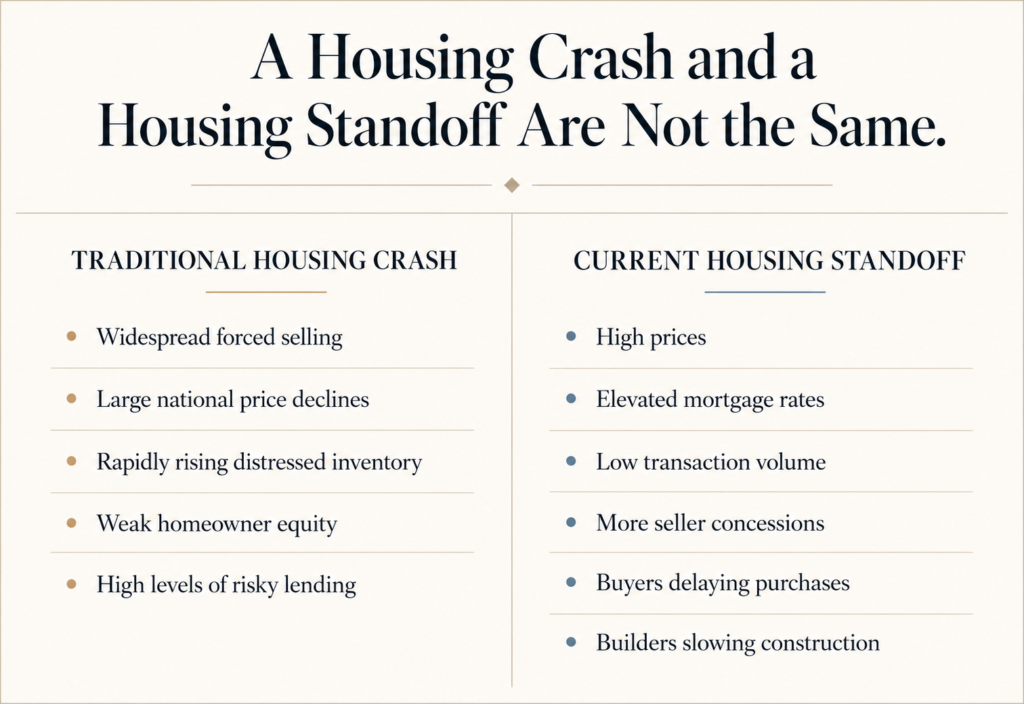
The current data does not automatically point to a national housing crash.
Prices remain high in many markets, and the national median existing-home price reached another record during June.
Housing supply also remains limited in several parts of the country.
Foreclosure activity is rising, but it remains far below the levels associated with the 2008 housing crisis.
ATTOM reported foreclosure filings on more than 227,000 U.S. properties during the first half of 2026, representing a noticeable increase from the previous year.
The increase suggests that some homeowners are experiencing greater financial pressure.
However, the broader trend has been described as a gradual normalization rather than evidence of another nationwide foreclosure wave.
Most homeowners who purchased or refinanced before mortgage rates increased also have fixed-rate loans and meaningful equity.
That makes forced selling less likely than it was during the subprime mortgage crisis.
The more immediate risk may not be a dramatic crash.
It may be prolonged stagnation.
Sellers may refuse to reduce prices enough to attract buyers.
Buyers may continue waiting for lower rates.
Builders may slow construction while offering incentives on completed homes.
Transactions could remain depressed even if national home prices decline only modestly.
Should You Buy a Home Now or Wait?
There is no universal answer.
Buying may make sense for someone who:
- Plans to remain in the home for several years
- Has stable income
- Maintains emergency savings after closing
- Can comfortably afford the payment at today’s rate
- Finds a home that meets long-term needs
- Receives meaningful concessions or incentives
Waiting may be smarter for someone who:
- Would need to drain savings for the down payment
- Is counting on an immediate refinance
- Has uncertain employment or income
- Expects to move within a few years
- Would be stretched by property taxes, insurance and maintenance
- Feels pressured to buy simply because inventory is increasing
Buyers should never assume that refinancing will definitely be available soon.
Mortgage rates may decline, but the timing and size of any decline are uncertain.
A purchase should make financial sense based on the payment available today—not a future payment the buyer hopes to receive later.

The Bottom Line
The housing market is shifting toward buyers—but not in the way many people expected.
Buyers have more negotiating power than they did during the pandemic.
Sellers are providing more concessions.
Builders are cutting prices and offering incentives.
Starter-home inventory is beginning to recover in some regions.
But the monthly cost of homeownership remains extremely high.
That is the contradiction defining the 2026 housing market:
The market is giving buyers more power at the negotiating table while taking away much of their power at the bank.
The buyers who benefit most will not necessarily be the ones who wait for the largest advertised price reduction.
They will be the buyers who compare financing options, request the right concessions, preserve enough savings after closing and purchase a home that remains affordable even if mortgage rates do not decline anytime soon.
The market may be moving in the buyer’s direction.
Affordability still has a long way to go.
Resources
- National Association of Realtors: Pending Home Sales
https://www.nar.realtor/research-and-statistics/housing-statistics/pending-home-sales - National Association of Realtors: Existing-Home Sales
https://www.nar.realtor/research-and-statistics/housing-statistics/existing-home-sales - National Association of Home Builders: Housing Market Index
https://www.nahb.org/news-and-economics/housing-economics/indices/housing-market-index - U.S. Census Bureau: New Residential Construction
https://www.census.gov/construction/nrc/ - Freddie Mac: Primary Mortgage Market Survey
https://www.freddiemac.com/pmms - Mortgage News Daily: Current Mortgage Rates
https://www.mortgagenewsdaily.com/mortgage-rates - Realtor.com Research
https://www.realtor.com/research/ - Redfin Housing-Market News
https://www.redfin.com/news/ - ATTOM Foreclosure Market Reports
https://www.attomdata.com/news/market-trends/foreclosures/